
Quick Links: Complaints Policy | Appeals Policy | Formal Complaint Form
V:2.0
KSA Complaints Policy
The purpose of this policy is to ensure that all complaints raised by students, personnel, and other stakeholders are handled in a fair, transparent, and consistent manner. The policy aims to promote a culture of integrity and continuous improvement.
This policy applies to all complaints received from students, personnel, industry partners, and other stakeholders regarding the services, operations, or conduct of the organisation. This policy and processes implemented are aligned to requirements outlined in ISO 10002:2018 Quality management – Customer satisfaction – Guidelines for complaints handling in organisations.
The organisation is committed to providing a safe, supportive, and quality environment for all stakeholders. All complaints will be managed professionally, confidentially, and in accordance with the principles of natural justice, ensuring that complainants and respondents are treated fairly and respectfully.
1. Rationale
KSA ensures that students, personnel, and stakeholders are made aware of the feedback and complaints processes through multiple accessible channels. Information on these processes is clearly outlined in the KSA Student Handbook, organisational website, and enrolment documents. During orientation sessions and onboarding for both students and personnel, the complaints process is explicitly discussed to promote awareness. Regular reminders, posters, and digital communications further ensure stakeholders are well-informed.
KSA's complaints management system is designed to reflect the principles of fairness, timeliness, and effectiveness. Complaints are handled by unbiased personnel to ensure impartiality, and complainants are given the opportunity to present their case without fear of repercussions. A triage system is in place to prioritise complaints based on urgency and complexity, ensuring timely responses. Acknowledgements of receipt and updates on progress are provided regularly to maintain transparency. All complaints are resolved with procedural fairness, respecting the rights of all parties involved. Clear guidelines, training for personnel, and accountability measures, such as tracking complaints in the Complaints Register, ensure consistency and professionalism.
The outcomes of complaints are systematically analysed to identify trends, root causes, and opportunities for improvement. Substantiated complaints result in corrective actions that are documented in the Continuous Improvement Register, and relevant policies, procedures, or practices are updated accordingly. KSA conducts regular audits of the complaints handling process to assess its effectiveness and make adjustments as needed. Feedback from complainants is also used to inform strategic planning, risk management, and resource allocation, contributing to a culture of continuous improvement.
2. Guiding Principles
KSA’s complaints process and appeals process (refer Appeals Policy) reflects the fourteen (14) guiding principles as outlined in ISO 10002:2018.
Commitment | The organisation is actively committed to defining and implementing a complaints-handling process. |
Capacity | Sufficient resources are made available for and committed to complaints handling and are managed effectively and efficiently. |
Transparency | The complaints-handling process is communicated to customers, personnel and other relevant interested parties. Individual complainants are provided with adequate information about the handling of their complaint. |
Accessibility | The complaints-handling process is easily accessible to all complainants. Information is made available on the details of making and resolving complaints. The complaints-handling process and supporting information is easy to understand and use. The information is in clear language. Information and assistance in making a complaint is made available, in whatever languages or formats that services are offered or provided in, including alternative formats, such as large print, Braille, or audiotape where requested, so that no complainants are disadvantaged. |
Responsiveness | The organisation addresses the needs and expectations of customers with respect to complaints handling. |
Objectivity | Each complaint is addressed in an equitable, objective and unbiased manner through the complaints-handling process. Please refer to the principles of objectivity below for further information. |
Charges | Access to the complaints-handling process is free of charge to the complainant. |
Information integrity | The organisation ensures that the information about its complaints handling is accurate and not misleading, and that data collected are relevant, correct, complete, meaningful and useful. |
Confidentiality | Personally identifiable information concerning the complainant is available where needed, but only for the purposes of addressing the complaint within the organisation and is actively protected from disclosure, unless the customer or complainant expressly consents to its disclosure or disclosure is required by law. |
Customer-focused approach | The organisation adopts a customer-focused approach with respect to handling complaints and is open to feedback. |
Accountability | The organisation has established and maintains accountability for, and reporting on, the decisions and actions with respect to complaints handling. |
Improvement | Increased effectiveness and efficiency of the complaints-handling process is a permanent objective of the organisation. |
Competence | Organisation personnel have the personal attributes, skills, training, education and experience necessary to handle complaints. |
Timeliness | Complaints are handled as expeditiously as feasible given the nature of the complaint and of the process used. |
KSA complaints process is free, and easily available, to manage and respond to allegations involving the conduct of:
- KSA, its trainers, assessors or other personnel, or
- A student of KSA
Objectivity
KSA is committed to the principles for objectivity in the complaints-handling process.
Openness | Well publicised, accessible, and understood by those involved in a complaint. The process is clear and well publicised so that both personnel and complainants can follow. |
Impartiality | Avoiding any bias in dealing with the complainant, the person complained against, or the organisation. The process is designed to protect the person complained against from any biased treatment. Emphasis is placed on solving the problem and not on assigning blame. If a complaint is made about personnel, the investigation is carried out independently. |
Confidentiality | The process is designed to protect the complainant’s and customer’s identity, as far as is reasonably possible. This aspect is very important to avoid deterring possible complaints from people who might be afraid that giving details could lead to inconvenience or discrimination. |
Accessibility | The organisation allows the complainant access to the complaints-handling process at any reasonable point or time. Information about the complaints process is readily available in clear language and in formats accessible to all complainants. When a complaint affects different supply chain participants, a plan to coordinate a joint response is made. The process allows any information arising from the complaints to be known by any suppliers of the organisation that are concerned by the complaint so that they are able to make improvements. |
Completeness | Finding out the relevant facts, talking to people from both sides involved in the complaint to establish a common ground, and verifying explanations, whenever possible. |
Equitability | Giving equal treatment to all people. |
Sensitivity | Each case is considered on its merits, paying due care to individual differences, and needs and expectations. |
Objectivity for Personnel
Complaints-handling procedures ensure that those complained against are treated objectively. This includes:
- Informing them immediately and completely on any complaint about their performance.
- Giving them the opportunity to explain the circumstances and allowing them appropriate support.
- Keeping them informed of the progress in the investigation of the complaint and the result.
It is vital that those against whom a complaint has been made are given full details of the complaint before they are interviewed. However, confidentiality should be observed.
KSA personnel are reassured that they are supported by the process. Personnel are encouraged to learn from the complaints-handling experience and to develop a better understanding of the complainant's perspectives.
The complaints-handling process ensures confidentiality in the case of complaints against personnel. The details of such complaints are known only by those directly concerned.
3. Complaints Process Approach
KSA is open to receiving feedback and complaints and ensures information about how to provide feedback and make complaints is publicly available and easily accessible, including via the KSA Student Handbook and website. The organisation takes a best practice approach that:
- Fosters a receptive, blame-free culture that is open to feedback and improvement.
- Ensures there is no detriment to people who complain.
- Makes it easy and accessible for people to provide feedback and make complaints.
Students are supported to provide feedback and make complaints. Allowing students to easily engage with the personnel of KSA about any concerns they have can stop minor issues becoming larger. There are a range of avenues through which complaints can be made. This includes in person made directly to KSA representatives, via phone or in writing, including via email or KSA website. However, to initiate the Formal Grievance Process, complaints must be submitted in writing via the KSA website or email to ensure a formal record is established.
The organisation actively seeks to remove any barriers to making complaints and any fear of repercussions to the complainant. Complaints are handled impartially, with respect for all parties involved, reflecting procedural fairness and natural justice. KSA personnel are well trained and supported to manage complaints, acknowledging promptly and providing timely responses.
Complaints are resolved without unnecessary delay. KSAs recognises that some complaints may require more urgent attention than others, and that some complaints may take longer to resolve than others. KSA’s process includes triaging complaints where needed.
The organisation communicates transparently with stakeholders about the expected timeframes for acknowledging, resolving and communicating the outcomes of complaints. In any situation where timeframes are not being met (because the complaint is taking longer to resolve than anticipated) KSA maintains regular contact with the complainant including to explain any delays.
All complaints are handled by an unbiased person.
KSA ensures the privacy of complainants, and the confidentiality of information included in a complaint.
Reflecting the principles of natural justice and procedural fairness, both the complainant(s) and the subject(s) of each complaint are given an opportunity to be heard and to provide relevant information before a decision is made.
The KSA Chief Executive Officer has overall responsibility for managing complaints and communicating their value to the organisation. KSA ensures:
- Personnel at all levels understand and comply with complaints management policies and procedures,
- Personnel have received appropriate guidance, training and support to handle complaints,
- Students are directed to the complaints process and supported to lodge complaints when they experience a problem or have an issue, and
- Personnel performance is monitored to ensure complaints are handled properly and appropriate remedies are provided.
KSA maintains a student complainant’s enrolment during any complaint process.
4. Complaint, Grievance and Dispute Resolution Procedure
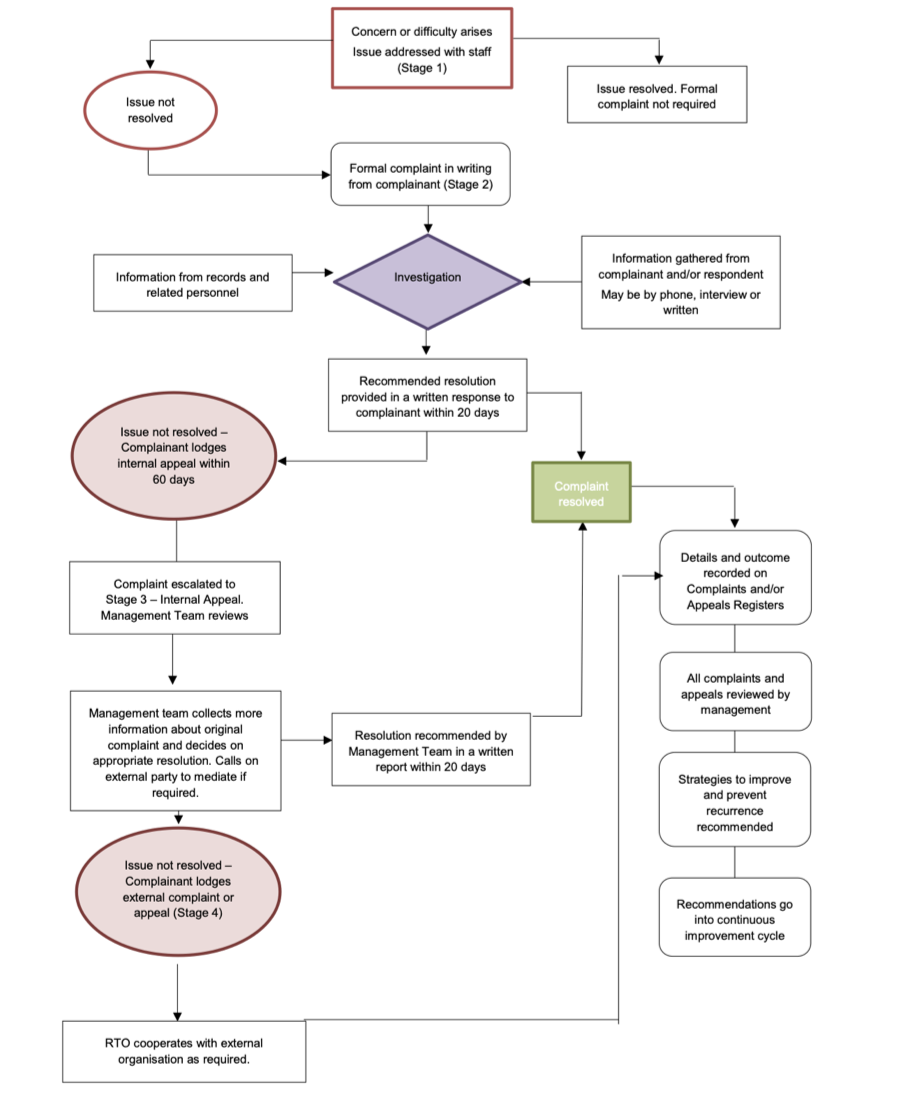
Complaints Handling Flowchart
Escalation Flowchart
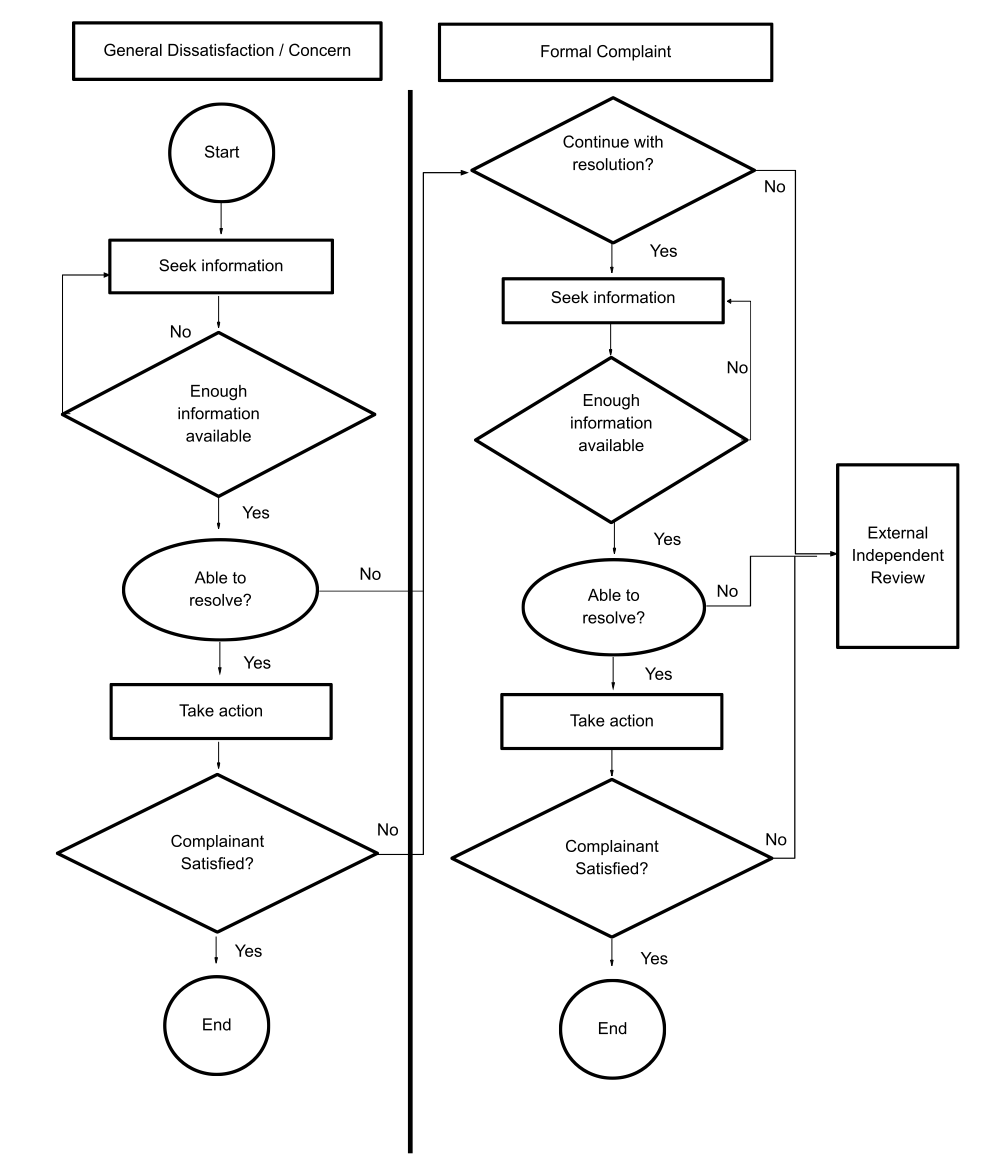
The following complaints handling framework has therefore been implemented for any stakeholder raising a complaint or issue. This procedure applies to all complaints, including those about:
- Academic matters from students,
- Non-academic matters from students, and
- Non-academic matters from persons seeking to enrol with the KSA in a VET course or unit of study.
No fees are applicable or levied to the student or other complainant for any stage of the complaints process.
- In the first instance the complainant should discuss the matter with the personnel member or responsible person concerned. Where this is not considered appropriate then the complainant is encouraged to discuss the matter with KSA management.
If the complainant is satisfied with the outcome of the discussion, it would mean that the matter is resolved.
- Any stakeholder may submit a formal complaint to KSA. Complaints information captured includes:
- Submission date of complaint,
- Name of complainant,
- Nature of complaint,
- Date of the event / activity which lead to the complaint,
- The products and services or related organisation practices complained about,
- A description of the complaint and relevant supporting data,
- Any other relevant information or attachments (if applicable),
- The requested remedy,
- Immediate action taken (if any), and
- The due date for a response.
All stages of the complaints process are documented. Complaints may be lodged via various channels including in-person via KSA personnel, via telephone and via email.
All complaints are immediately recorded in the KSA Complaints Register.
- KSA commences processing of complaints as soon as practicable and within two (2) business days of a complaint being made and finalises the outcome as soon as practicable, preferably on the first contact if the complaint is straightforward. Complaints are assessed on a risk-based approach to assign them priority, considering items such as severity, safety implication, complexity, impact, and the need and possibility of immediate action. Personnel are alert in particular to the needs of students who are vulnerable or require special assistance.
Simple complaints may be easily addressed by the personnel who has received the complaint. More complex complaints are allocated to the KSA Quality Manager in the first instance. Serious complaints are immediately reported to the KSA Chief Executive Officer, who may allocate alternate or additional resourcing to the investigation and processing of the complaint.
- KSA acknowledges receipt of complaints in writing immediately, as soon as practicable, and:
- Arranges a suitable time if needed to discuss the complaint,
- Advises complainants of expected timeframes, and
- Gives complainants the contact details of the allocated contact person they can speak to about their complaint.
- The KSA Quality Manager investigates complaints or refers matters to appropriate KSA personnel for investigation. In either case, investigations are expected to be resolved, and decisions made on the complaint as soon as practicable and within twenty (20) working days of the complaint being received in writing.
Complainants are given an opportunity to formally present their case at no cost and be accompanied and assisted by a support person at any relevant meetings.
An up-to-date status is made available to the complainant upon request and at regular intervals.
Decisions and outcomes of all complaints are merit-based decisions that consider all available evidence. KSA ensures complaints are considered with an open mind and without bias arising from any past issues with the complainant.
Issues raised in complaints are analysed to determine cause(s) and the root cause evident.
- Complainants are advised on the outcome of complaints in writing, including detailed reason(s) for the outcome, explanations for decisions and remedies where appropriate.
The organisation ensures appropriate responses to complaints are provided promptly, addressing the needs and expectations of complainants while aligning with organisational policies and legal obligations.
Responses are designed to resolve the complaint effectively and prevent recurrence where applicable.
Types of Responses
Depending on the nature and severity of the complaint, the organisation’s responses may include, but are not limited to:
- Issuing refunds where justified.
- Providing replacements for faulty or unsatisfactory products/services.
- Conducting repairs or rework to address service/product issues.
- Offering substitute products or services.
- Delivering technical assistance to resolve specific concerns.
- Sharing information to clarify the issue and its resolution.
- Making referrals to relevant personnel, departments, or external parties.
- Providing financial assistance where appropriate.
- Offering other assistance as deemed necessary.
- Awarding compensation for damages or inconvenience caused.
- Issuing an apology to acknowledge the organisation’s responsibility.
- Offering a goodwill gift or token as a gesture of sincerity.
- Implementing changes to products, services, processes, policies, or procedures based on the complaint.
Implementation Considerations
The organisation will take into account the following when deciding on and implementing responses:
- Addressing all aspects of the complaint comprehensively to ensure resolution.
- Conducting follow-ups where appropriate to confirm complainant satisfaction and resolution effectiveness.
- Determining if it is suitable to extend remedies to others who might have been similarly affected but did not file formal complaints.
- Ensuring the level of authority required for approving various types of responses.
- Ensuring the dissemination of information about the response to relevant personnel for proper action and future prevention.
Response Authorisations | ||
|---|---|---|
Response Type | Approval Level Required | Notes |
Refunds (up to $500) | Supervisor or Manager | Refunds exceeding $500 require Chief Executive Officer approval. |
Replacement of Products | Manager | Ensure replacement aligns with warranty or return policies. |
Repair/Rework | Technical Team Lead | Repairs/rework beyond $1,000 require written approval from the Chief Executive Officer. |
Substitutes | Supervisor | Substitutes must be of equal or greater value than the original product/service. |
Technical Assistance | All personnel | No additional approval required for standard technical assistance requests. |
Information Requests | All personnel | Information shared must comply with privacy and confidentiality policies. |
Referral to External Parties | All personnel | Ensure referral agreements are in place before providing details to external parties. |
Financial Assistance | Supervisor or Manager | Any assistance above $500 requires Chief Executive Officer approval. |
Other Assistance | Supervisor or Manager | Assistance must align with organisational policy and available resources. |
Compensation | Chief Executive Officer | Compensation claims exceeding $2,000 require Board approval. |
Apology | All personnel | Standard apologies can be issued, escalations require Supervisor approval. |
Goodwill Gift or Token | Supervisor or Manager | Gifts exceeding $100 in value require Chief Executive Officer approval. |
Policy/Process Changes | Chief Executive Officer | Significant changes require consultation and formal approval by the governing body. |
All approvals must be recorded in the Complaints Register, including the name and role of the approver.
If an approver is unavailable, the request should be escalated to the next level of authority.
This procedure ensures all responses are effectively authorised, documented, communicated effectively to the complainant, and aligned with the overall complaints-handling framework.
With this notification, all complainants receive information on how they can progress their complaint if still unhappy.
If a complainant is not satisfied with the outcome, they may appeal the decision.
Please refer to the Appeals Policy below for further information.KSA securely maintains records of all details of the complaints process and retains evidence of all documentation relevant. Each complaint and its outcome is recorded via the Complaints Register. This register is located at:
KSA Head Office, Level 1, 54 Torquay Road, Pialba, QLD, 4655
Complaints Processing Delays
If at any stage KSA considers more than twenty (20) working days are required to process and finalise a complaint, KSA:
- Informs the complainant in writing, including reasons why more time is required, and
- Regularly updates the complainant on the progress of the matter.
KSA retains records of all complaints and grievances for a period of at least ten (10) years, allowing parties to the complaint or grievance appropriate access to these records.
5. Complaints Key Contacts
If a complainant is not satisfied with the resolution of a complaint, they may seek further assistance from the following additional parties as relevant:
Organisation | Details |
|---|---|
Australia Skills and Quality Authority (ASQA) | Ph. 1300 701 801 www.asqa.gov.au |
6. Improvement Actions
KSA is committed to take appropriate action in any case where a complaint is substantiated. In cases where a complaint is upheld, KSA endeavours to identify the root cause of the complaint and takes appropriate action to prevent the situation from happening again.
All improvement actions arising from complaints are raised via an Improvement Record. KSA maintains a Continuous Improvement Register for recording the receipt and management of improvement records.
KSA:
- Regularly analyses complaints to identify trends and any further improvements needed,
- Audits the complaints process on an annual basis to assess its effectiveness and improve the complaints process as needed.
Please refer to the Quality Policy for further information on the continuous improvement process.
7. Monitoring and Evaluation
KSA monitors and evaluates the complaints handling process to ensure complaints are handled objectively.
A process of performance monitoring, evaluation, and reporting has been established and implemented.
The organisation continually improves the effectiveness and efficiency of processes. Process performance and outcomes are regularly audited to identify and remove causes of existing and potential problems, as well as to uncover any opportunities for improvement.
Please refer to the Quality Policy for further information on the monitoring and evaluation process.
KSA Appeals Policy
The purpose of this policy is to ensure that all appeals raised by students, personnel, or other stakeholders regarding decisions made by the organisation are managed fairly, transparently, and consistently. The appeals process is designed to uphold the principles of natural justice and ensure that all parties are treated equitably.
This policy applies to all appeals relating to decisions made by the organisation, including but not limited to:
- Application outcomes.
- Assessment outcomes.
- Disciplinary actions.
- Complaints resolution outcomes.
This policy and processes implemented are aligned to requirements outlined in ISO 10002:2018 Quality management – Customer satisfaction – Guidelines for complaints handling in organisations.
1. Rationale
KSA ensures that students, personnel, and stakeholders are made aware of the appeals process through various accessible and transparent communication channels. Information about the appeals process is prominently featured in the KSA Student Handbook, organisational website, and enrolment materials. During onboarding and orientation sessions for students and personnel, the appeals process is explained to promote understanding. Ongoing reminders via digital communications and other channels ensure stakeholders have continuous access to this information.
KSA’s appeals management system is designed to uphold fairness, timeliness, and effectiveness through a structured and impartial process. Appeals are handled by unbiased personnel who are independent of the original decision being reviewed. If the CEO was the original assessor, a qualified external contractor or a peer RTO owner will be engaged for the "Formal Internal Appeal" stage. The process ensures that appellants have an opportunity to formally present their case and are supported by clear communication and transparent timelines. Appeals are acknowledged promptly, and stakeholders are regularly updated on the progress of their appeals. Decisions are merit-based, considering all available evidence, and the process adheres to the principles of natural justice and procedural fairness. Additionally, all appeals are documented in the Appeals Register to maintain accountability and consistency.
KSA systematically analyses appeals outcomes to identify trends, root causes, and areas for improvement. Substantiated appeals are documented in the Continuous Improvement Register, and corrective actions are implemented to prevent recurrence. Outcomes of appeals inform policy and procedural updates, ensuring alignment with best practices and stakeholder expectations. Regular audits of the appeals process are conducted to assess its effectiveness and identify further opportunities for refinement. Feedback from appeals also informs resource allocation, risk management, and strategic planning, contributing to the organisation’s culture of continuous improvement.
2. Approach
KSA’s appeals process reflects the fourteen (14) guiding principles as outlined in ISO 10002:2018 (refer Complaints Policy).
KSA is committed to providing a fair and transparent appeals process that allows individuals to seek a review of decisions that directly affect them. All appeals are managed in a timely, impartial, and confidential manner.
KSA’s appeals process reflects the following key expectations:
- Right to appeal. All stakeholders have the right to lodge an appeal if they believe a decision was unfair or incorrect.
- Accessibility. The appeals process is easily accessible and user-friendly.
- Transparency and procedural fairness. Appeals are handled impartially, with a clear process and open communication at all stages.
- Timeliness. Appeals are acknowledged and resolved promptly, with clear timeframes communicated to all parties.
- Continuous improvement. Outcomes of appeals inform continuous improvement within the organisation.
Stakeholders are informed about avenues for appeal with information about how to make an appeal publicly available and easily accessible, including via the KSA Student Handbook and website.
Grievances or issues not pertaining to decisions made by the organisation should be referred to KSA’s complaints process.
3. Grounds for an Appeal
Appeals may be considered valid and accepted for review under the following grounds:
- Procedural fairness or irregularity. Where it is believed that the original decision was made without following established procedures or policies, resulting in an unfair or biased outcome.
- New evidence. When new, relevant evidence becomes available that was not considered during the original decision-making process, and this evidence has the potential to affect the outcome.
- Incorrect or unjust application of policies or standards. If it is believed that the policies, procedures, or standards were incorrectly applied or interpreted, leading to an unjust decision.
- Bias or conflict of interest. If there is evidence of bias, discrimination, or a conflict of interest by the person(s) involved in making the original decision.
- Assessment outcome disputes. When a student believes that an assessment decision was unfair, inconsistent with assessment criteria, or not conducted in accordance with the organisation’s assessment policies and standards.
- Severity of outcome or penalty. If the appellant believes the outcome or penalty applied was disproportionate, harsh, or unreasonable in relation to the situation.
These grounds ensure that appeals are raised on legitimate and substantive bases, supporting the organisation’s commitment to fairness, transparency, and continuous improvement.
KSA’s appeals process is free, easily accessible and facilitates requests for a review of decisions, including assessment decisions made by KSA.
The appeals process follows the principles of natural justice and procedural fairness by allowing anyone subject to a decision by KSA, or anyone who has allegations made against them, to tell their side of the story before a decision is made.
KSA maintains a student appellant’s enrolment during any appeal process.
KSA’s process ensures that the decision-maker is independent of the decision being reviewed (for example, an assessor does not consider or decide an appeal against an assessment decision they made).
4. Appeal and Dispute Resolution Procedure
- Before making a formal appeal, individuals are encouraged to discuss the matter with the relevant KSA personnel in an effort to reach a shared understanding of the matter and agreement.
If a stakeholder is still unhappy, they may lodge a formal appeal in writing to the KSA Chief Executive Officer.
- Any stakeholder may submit a formal appeal to KSA about a decision. Appeals information captured includes:
- Submission date of appeal,
- Name of appellant,
- Nature of appeal,
- Date of the event / activity which lead to the appeal,
- The products and services or related organisation practices relevant,
- A description of the appeal and relevant supporting data,
- Any other relevant information or attachments (if applicable),
- The requested remedy,
- Immediate action taken (if any), and
- The due date for a response.
All stages of the appeals process are documented. Appeals may be lodged via various channels including in-person via KSA personnel, via telephone and via email.
All appeals are immediately recorded in the KSA Appeals Register.
- KSA commences processing of appeals as soon as practicable and within five (5) business days of an appeal being made and finalises the outcome as soon as practicable.
Appeals are allocated to the KSA Chief Executive Officer, who may allocate alternate or additional resourcing to the investigation and processing of the appeal. If the CEO was the original assessor, an independent external assessor will be engaged to ensure an unbiased review.
- KSA acknowledges receipt of appeals in writing immediately, as soon as practical, and:
- Arranges a suitable time if needed to discuss the appeal,
- Advises appellants of expected timeframes, and
- Gives appellants the contact details of the allocated contact person they can speak to about their appeal.
An up-to-date status is made available to the appellant upon request and at regular intervals.
- Appeal investigations are expected to be resolved, and decisions made on the appeal as soon as practical and within twenty (20) working days of the appeal being received in writing.
Appellants are given an opportunity to formally present their case at no cost and be accompanied and assisted by a support person at any relevant meetings.
Decisions and outcomes of all appeals are merit-based decisions that consider all available evidence. KSA ensures appeals are considered with an open mind and without bias arising from any past issues with the appellant.
Issues raised in appeals are analysed to determine cause(s) and the root cause evident.
- Appellants are advised of the outcome of the appeal in writing, including detailed reasons for the outcome. With this notification, appellants also receive information on how they can progress their appeal if still unhappy.
- If an appellant, on receiving written advice on the initial appeal, is still unhappy they may escalate the appeal to the KSA Chief Executive Officer for independent external review. Escalated appeals are to include the following information:
- Submission date of appeal,
- Name of appellant,
- Nature of appeal,
- Reasons why the appellant is not satisfied with the outcome of the original appeal, and
- Any other relevant information or attachments (if applicable).
- KSA Chief Executive Officer acknowledges receipt of escalated appeals in writing as soon as possible and within five (5) working days of receipt of the appeal.
The Chief Executive Officer refers the matter to an external dispute resolution process by a body appointed for this purpose by KSA. The default external body available is:
National Training Complaints Hotline (If you have a complaint relating to your experiences whilst undertaking training in the vocational education and training (VET) sector, the National Training Complaints Hotline can refer your complaint to the most appropriate authority to have your complaint considered).
or the Queensland Training Ombudsman They are free, independent, and specifically designed for QLD students. They can actually review the process and provide a recommendation to review the case).
KSA gives due consideration to any recommendations arising from the external review within ten (10) working days of the receipt of the recommendations, including implementing the decision(s) or recommendation(s) and/or taking the preventive or corrective action(s) required by the decision and advises the appellant of that action in writing.
Investigations are expected to be resolved, and decisions made on the appeal as soon as practical and within twenty (20) working days of the escalated appeal being received in writing.
Appellants are advised on the outcome of appeals in writing, including detailed reason(s) for the outcome, explanations for decisions and remedies where appropriate.
KSA securely maintains records of all details of the appeals process and retains evidence of all documentation relevant. Each appeal and its outcome is recorded via the Appeals Register. This register is located at:
KSA Head Office
Level 1, 54 Torquay Road,
Pialba, QLD, 4655
Appeals Processing Delays
If at any stage KSA considers more than twenty (20) working days are required to process and finalise an appeal, KSA:
- Informs the appellant in writing, including reasons why more time is required, and
- Regularly updates the appellant on the progress of the matter.
KSA retains records of all appeals for a period of at least ten (10) years, allowing parties to the appeal access to these records.
5. Improvement Actions
KSA is committed to take appropriate action in any case where an appeal is upheld. In cases where a appeal is upheld, KSA endeavours to identify the root cause of the matter that was appealed and takes appropriate action to prevent the situation happening again.
All improvement actions arising from appeals are raised via an Improvement Record. KSA maintains a Continuous Improvement Register for recording the receipt and management of improvement records.
KSA:
- Regularly analyses appeals to identify trends and any further improvements needed,
- Audits the appeals process on an annual basis to assess its effectiveness and improve the appeals process as needed.
Please refer to the Quality Policy for further information on the continuous improvement process.
6. Monitoring and Evaluation
KSA monitors and evaluates the appeals process to ensure appeals are handled objectively.
A process of performance monitoring, evaluation, and reporting has been established and implemented.
The organisation continually improves the effectiveness and efficiency of processes. Process performance and outcomes are regularly audited to identify and remove causes of existing and potential problems, as well as to uncover any opportunities for improvement.
Please refer to the Quality Policy for further information on the monitoring and evaluation process.
Submit A Formal Complaint
To initiate the formal grievance process, please download the form below and email to admin@kinesiologyschoolsaustralia.com.au . In accordance with the KSA Complaints and Appeals Policy, your submission must include specific details regarding the incident(s), including dates, locations, and the parties involved. Once received, KSA will provide a written acknowledgement of your complaint and begin a formal investigation. We are committed to resolving all matters with procedural fairness and will provide a formal response within 20 working days.